Effective Use of Borescopes
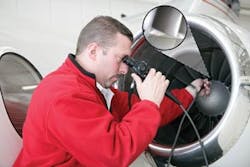
With their ability to see places where the unaided human eye can’t, borescopes are incredibly valuable for aircraft maintenance technicians. But like all good tools, there are right ways and wrong ways to use borescopes; especially when it comes to nondestructive testing (NDT) of components and airframes.
To get a clear view on this issue, AMT spoke to Sean O’Connor, U.S. sales manager for RF System Lab; Doug Kindred, president of Gradient Lens Corp.; and Laura Bustamante, senior product manager at Olympus.
AMT: How are borescopes used for NDT applications in aviation maintenance?
O’Connor: First of all, while the term “borescope” is often used to refer to any type of remote visual inspection (RVI) tool, there is a difference between a “borescope,” a “fiberscope,” and a “videoscope.” Strictly speaking, a borescope is a rigid optical instrument that can be used when you have direct, straight line access to the object being inspected. Mirrors or prisms are usually used to carry the image from the distal end of the borescope to an eyepiece or camera located at the proximal end.
Unlike borescopes, fiberscopes are flexible instruments that can bend through curves and channels in order to gain visual access to an inspection area. With a fiberscope, fiberoptic bundles carry light to the distal end of the insertion tube, illuminating the inspection area. Other fiberoptic strands within the insertion tube carry the image back [to] where it is viewed through an eyepiece or captured by a camera that can then display the image on a monitor. Some fiberscopes have directional controls and an articulating tip that allow the user to point the distal end of the insertion tube in any direction once it is inserted into an inspection area.
Videoscopes are the latest advancement in RVI. With a videoscope, a very small camera is placed at the distal end of the insertion tube, allowing direct video access to the area being inspected. The image is displayed in real time, usually on an integrated viewing monitor. Because there is no intermediate step of carrying the image through fiberoptic bundles before viewing, videoscopes have much higher resolution and image clarity when compared to traditional fiberscopes. Also, most videoscopes have built-in image capture and video recording capabilities, which makes documentation, image sharing, and archiving much easier.
Whether using a borescope, fiberscope, or videoscope, there are a number of important applications for RVI instruments in aviation maintenance. Generally speaking, these applications could be lumped into three categories: engine inspection, airframe inspection, and FOD (foreign object damage) detection.
Bustamante: With borescopes and videoscopes you can get to what’s not seen with the eye, things that you have no immediate access to and can’t immediately get to. There’s also a higher cost to take things apart to get to. That’s the main reason. Second is to get to and see inside airframe or any small area you can’t physically get to without a significant amount of time or money.
AMT: What elements of RVI instruments make them so well suited for NDT work?
O’Connor: Simply stated, RVI instruments allow a technician to conduct a visual inspection of an area that otherwise could not be seen with the unaided human eye. For any technician working on complex machinery or equipment, being able to look inside and inspect small or remote internal areas is a huge advantage. When we consider the financial costs and potential loss of life that can occur with the sudden failure of an aircraft component or system, effective RVI in aviation becomes not just an advantage but an absolute necessity.
Bustamante: Borescoping is like having an eye at the end of a cable. NDT is being able to inspect something without changing the actual structure of what you’re inspecting. You have something that’s small enough to get inside small access areas like a screw hole that brings you inside of a frame. We have technology like articulation so you can navigate a cable through some pretty difficult small areas. With every type of instrument there is for NDT, nothing beats actually being able to see it. Whether it’s a video with a camera, or going more old school with a fiberscope, you see what you need to see. You can get a lot of tools to get you different readings, but in the end nothing beats having somebody looking at it.
AMT: What parts of the airframe and engine are best suited for RVI work?
O’Connor: Different airframes will have different requirements, but a sampling of items that are inspected using RVI include bell cranks, cable attachments, hose and wiring connections and condition, the inside of wing spars, and, with composite airframes, delamination inside composite panels. RVI is also helpful in reading component ID plates and serial numbers, checking for loose nuts or bolts, inspecting the compass compartment on larger aircraft, and for locating the source of fuel or other fluid leaks.
For piston-powered aircraft, a technician will inspect the inside of the cylinder to look for scorched pistons, cross-hatching on the combustion chamber walls, and valve condition.
With turbine-powered aircraft, RVI is used to inspect the turbine blades, nozzle guide vanes, and to look for any foreign object damage.
Kindred: The basic two most common things are inspecting turbine and compressor blades in engines and combustion chamber. When using RVI on the blades you’re looking for cracks from wear or impact. When inspecting a combustions chamber you’re looking for cracks, faulty fuel injectors, or anything that looks like it could be wrong. You use RVI so you don’t have to take the whole thing apart.
AMT: What are the “tricks of the trade” for using RVI tools effectively?
O’Connor: Keep in mind that modern RVI instruments are packed with electronics. A videoscope will not only have circuit boards and a power pack, but also a micro-camera, lens, articulation controls, and LEDs or fiberoptics for illumination. Accidents will happen, but dropping a videoscope from the horizontal stabilizer of a 757 has different implications than dropping a screwdriver from the same height. Treat the instruments kindly and they will provide years of trouble-free service.
When in doubt, take a picture. Videoscopes (and fiberscopes and borescopes if they have a camera attachment) allow you to capture images and video during an inspection. If there is any question as to whether or not there is a problem with the item you are inspecting, take a picture and get a second opinion. It is a lot easier to delete an image later than it is to go back and find the questionable area a second time.
When using guide tubes, if possible, place the instrument’s insertion tube through the guide tube before putting the guide tube into the inspection area.
During use, RVI instruments will often come into contact with fluids or debris. This is not a problem, but be sure to follow the manufacturer’s instructions when cleaning the instrument, especially the lens, prisms, or eyepiece.
Kindred: The key is to use the right product. Some guys will use whatever old scope they have laying around. Sometimes a rigid or flexible scope or a videoscope is the best tool. It’s best to have a full arsenal of good quality borescopes so you can use the right one for the application.
Bustamente: First of all is training, training, training — knowing your tool and having the experience of how to use it effectively. One person to the next might not use it the same. It’s kind of like a camera — like if you and Annie Liebowitz both took pictures, you aren’t going to take the same picture that she does. Learning the actual tool helps reduce cost and time.
Getting the best tool is also important. There are so many alternatives, especially with lots of lower end products, but just because they’re less expensive ... do you want to risk your inspection? A difference in quality equals a difference in confidence in your inspection, and especially on aircraft engines — those are the type of things where you need to see what you need to see to see if engine can still go. People’s lives depend on it.
So much RVI equipment is coming in from the low end has bare bones image quality. When we design we design for best image quality for the most confident inspection and decisions. Where do you really want to sacrifice?
AMT: Finally, can you conclude by giving us some tips to remember when using RVI tools?
O’Connor: It goes without saying, but just as with all other aspects of your work, always remember that lives are on the line. Unlike a car, if there is a critical failure at 30,000 feet, your aircraft cannot simply pull to the side of the road.
- Be thorough.
- Use the best instruments you can afford.
- When in doubt, ask for a second opinion.
Remember that RVI is only one aspect of NDT, and it is not a universal solution. When used in concert with radiography, eddy current, or ultrasonic NDT methods, RVI helps to provide a complete picture of your aircraft.
Bustamante: Practice. There’s different tip adapters, like there are different lenses in a camera. Know what tips are available and when to use them. Today’s RVI equipment is digital and you need to know how to use that type of technology, like how to bring images into a computer … there’s so much potential for doing more if you get to know it and embrace the technology.