A Primer on Fire Extinguishers
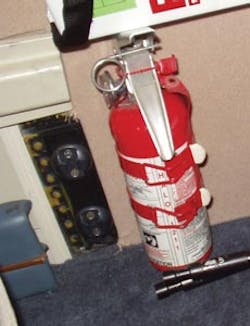
It was at 4,500 feet on a dark night near Purcell, OK, when the rear seat passenger of a Piper Warrior noticed the seat getting warm and the smell of smoke. Very quickly, the passengers found themselves attempting to control an in-flight fire with blankets and bottled water as the pilot put the plane down on an Interstate highway. Everyone cleared the aircraft and watched the cabin section burn … there was no fire extinguisher aboard.
It’s stories like that remind us of the importance of a fire extinguisher aboard an airplane. While the need for a fire extinguisher is well understood, the proper installation and maintenance of onboard fire extinguishers isn’t understood nearly as well. There’s sound reason for ensuring proper maintenance is accomplished ‘cause when you need a fire extinguisher in flight — you need it bad.
It may surprise some that, for Part 91 operations, fire extinguishers aren’t a mandatory piece of equipment on most aircraft … which means without a requirement there isn’t specific guidance regarding what you should have on the aircraft for fire fighting. For the prudent pilot, this may be more of a blessing than an overlooked bit of regulation by the Feds. Without specific guidance, the FAA isn’t going to be telling you precisely what you need to carry to protect yourself from a fire, which means the average pilot should be able to afford at least a minimal amount of protection, even in rental aircraft.
Does this mean the FAA doesn’t care about in-flight fire-fighting equipment? Not at all. The freedom to choose under Part 91 does not extend into the enhanced safety regulations of Part 135 or Part 121 air carrier operations. The FAA long ago established guidance for hand-held fire extinguishers, which our safety-conscious pilot would do well to follow. From a safety standpoint, carrying anything less than the equipment required by the FAA for Part 135 operators is doing a disservice to yourself and your passengers. It is for this reason we’ll turn our attention to Advisory Circular (AC) 20-42C, Hand Held Fire Extinguishers for Use in Aircraft, and dispense with any discussion of non-Part 135 requirements and use only air carrier guidance on the care and feeding of hand-held fire extinguishers aboard the aircraft.
Where to find it: regulatory guidance
Essentially, the FAA has wisely delegated the hand-held fire extinguisher issue to agencies well qualified to determine the fitness of an extinguisher to fight a fire. In accordance with FAR 21.305 (d), the Administrator is allowed and has determined fire extinguishers may be considered FAA-approved through their acceptance by any of the following three agencies: the U.S. Coast Guard (USCG), Underwriter’s Laboratories (UL), or Factory Mutual Research Corporation (FMRC). The reader may be familiar with the first two, the third is more of an insurance industry qualifying group. Two things are important to note regarding this: the AC was written in 1984 and the USCG no longer performs its own approvals of fire extinguishers — USCG approval is now accomplished by UL or UL Canada.
I spoke with the FAA Flight Standards office in Washington, D.C., as well as an instructor at the FAA Academy in Oklahoma City and both agree the only guidance the FAA provides the aviator is through AC 20-42C (with the relevant FARs cited in the AC). The representatives also were clear the fire extinguisher does not need to be FAA approved in any way. It doesn’t need a yellow tag from an A&P nor does it need an FAA form 8130. If you’re a Part 135 operator, your extinguisher needs to be approved by the agencies cited above, but beyond that you don’t need any extraordinary documentation.
As a Part 91 operator, why do you care if your extinguisher is approved by UL? It comes down to quality. UL-approved extinguishers meet industry standards for safety in storage and use. It means, if properly maintained, the tank won’t corrode and burst at 10,000 feet. The valves and o-ring seals won’t crack and leak at -20 F. The handle won’t fall off when you bring it up to use it. The additional cost to have the UL rating is insignificant and, considering the number of years the extinguisher will hide in your airplane, becomes meaningless as a decision factor. It’s pointless to buy anything else.
What kind of extinguisher to use?
In choosing a fire extinguisher, you need to consider the aftermath of using it. Once the fire is out, improper extinguisher selection may cause short-term and long-term issues with the pilot/passengers as well as the aircraft.
A carbon dioxide extinguisher, while effective in smothering a fire, can also be effective in smothering the occupants. The enclosed space of an aircraft cabin will trap the gas and, unless you’re using oxygen or you can get your nose right up to the cabin vents, the accident report may show cause as pilot incapacitation. CO2 can be deadly in an airplane cockpit.
Dry chemical extinguishers can cause visibility and breathing problems if used in the close-in environment of the cockpit. The chemical powder can cause almost immediate problems with avionics and the corrosive nature of the extinguishing agent can have you cleaning and treating the airframe for years.
Other types, like water, may be good for one type of fire (paper/wood combustibles) but not good for another (like electrical and/or flammable liquid); the effects of water on avionics is so obvious it doesn’t warrant discussion.
The far-and-away best, FAA-endorsed, choice for aircraft fire extinguishers is the Halon extinguisher. Halon dispenses from the extinguisher in an easily aimed, longer range stream that vaporizes almost instantly when it comes in contact with a hot surface and stops a fire by displacing the oxygen feeding the fire.
Halon is incredibly effective in stopping fire. It has been found to stop combustion in extremely low concentrations (well below 5 percent); it is so effective at fire control it is used in sealed ultra-high-voltage switch boxes (at power stations and such) to eliminate arcing of the contact points, thus stopping the arc-induced wear on the contacts. And, unlike CO2, Halon has low toxicity so the airplane can be landed after the fire is out.
If Halon is the perfect fire extinguishing agent, why doesn’t everyone use it for everything? Well, it’s been found to have some undesirable effects on the earth’s ozone layer (this has been contested by several organizations). Halon, it was discovered in the ‘80s, floats around in the stratosphere and breaks down over time (50-100 years), releasing chlorine that is destructive to ozone. In 1994, the Montreal Protocol ozone-protecting international treaty ended Halon production. Halon continues to be stockpiled for use in aviation and other industries requiring its unique capabilities because of its ideal aviation fire-fighting qualities. Because of its limited use, Halon extinguishers are expensive compared to the others; a decent one for aircraft will run about $150-plus. But, a pocket full of money is worth little at 10,000 feet as you notice a glow under the instrument panel.
Not described in AC 20-42C is a fairly new product that, according to the manufacturer, has been FAA-approved as a substitute for Halon. The fire-fighting agent, called “Halotron I,” has been developed as an ozone-protecting answer to Halon. From available information, Halotron has the benefits of Halon but the knock-down effectiveness of Halotron is slightly less and requires a little larger quantity fire extinguisher to provide equivalent protection.
Regardless of extinguisher type, all should have a label describing proper operation the pilot needs to familiarize him-/herself with prior to flying the aircraft. This is especially true of rental pilots who may deal with several different brands of extinguishers.
Continued airworthiness of fire extinguishers
As a piece of emergency equipment, the FAA requires air carriers to have a maintenance program for fire extinguishers. Part 91 operators should also be equally concerned with their extinguishers, so let’s move on to extinguisher care.
As noted before, the FAA “approves” fire extinguishers based upon their acceptance by the USCG, UL, and FMRC. As the airworthiness certificate of an airplane is only valid if maintained in accordance with FAA-approved maintenance procedures, the UL certification is only valid if the fire extinguisher is maintained in accordance with a recognized inspection and maintenance program. For the USCG, UL, and FMRC that program is called “NFPA 10,” which stands for “National Fire Protection Association Standard No. 10.”
What SAE is to hardware, NFPA is to fire protection; it is a federally recognized standard that is reviewed and changed as fire protection evolves. NFPA 10 is the national authority on hand-held fire extinguisher installation and maintenance, which gets updated every few years as the NFPA deems necessary. Those familiar with NFPA standards will note another standard, NFPA 408, has been developed for aircraft hand-held fire extinguishers. If you look within NFPA 408, you’ll find fire extinguisher maintenance is to be accomplished IAW NFPA 10. For our maintenance discussion, then, we’ll stick with NFPA 10. For the 135 operator, it’s the required book for a 135 certification. According to NFPA, NFPA 10 is due to be revised this fall.
Halon extinguisher maintenance
Since we’re safety conscious, we’ve dispensed with the idea of having any other than a Halon extinguisher and only Halon requirements are discussed here. NFPA 10 covers a wide variety of fire extinguisher types. NFPA 10 is available at any fire safety equipment dealer or may be purchased on the Internet through the NFPA and other sources.
Halon and Halotron are known as “halogenated agents,” addressed within NFPA 10 as requiring inspections separate from other extinguishers. Briefly, NFPA recommends (and the USCG, UL, FMRC require) 30-day, annual, six-year, and 12-year inspections as described below (specific inspection requirements should be followed in NFPA 10):
1. 30-day inspection. The owner checks location, ensures no obstructions to use, and determines gauge pressure is in limits (Ref: NFPA 10, 2007 ed., para. 7.2.2).
2. Annual inspection. The owner does a general physical once-over of the extinguisher to determine if it’s lost pressure (via reading the gauge) or has any obvious damage, like a dent in the bottle (Ref: para. 7.3.2).
3. Six-year internal inspection. A certified facility empties, disassembles, internally inspects, re-assembles, and refills the extinguisher. Halogenated agents, it’s been learned, combine with moisture to create acids that can corrode cylinders internally (Ref: para. 7.3.1.1.2).
4. 12-year hydrostatic test. A certified facility does the six-year inspection, plus pressurizes the tank to proof test its integrity (Ref: para. 8.3.1).
The owner/operator, for a small fee ($5.00 locally), can have any extinguisher inspected for NFPA 10 compliance by dropping by a certified fire equipment business. A trained individual can perform a quick inspection to let you know if your extinguisher is safe to use, what inspections it is due (or will be due), and whether cylinder documentation is proper. Cheap insurance.
Tips on storage and use
Airplanes are generally short on space, so extinguishers sometimes get tucked into places where they become difficult to see and/or get to. The pilot should determine if, indeed, the fire extinguisher location is accessible and ensure it won’t get damaged by things bumping up against it.
A popular location for extinguishers is under the pilot/co-pilot seat; the owner needs to determine if the extinguisher can be quickly removed for use while flying the aircraft. It may look easy to get to standing in the doorway, but see what gyrations you have to go through to get it off the mount and aimed if sitting in the seat. It should also be checked to see that back seat passenger feet, purses, etc., can’t beat on the top of the extinguisher while stowed.
If you’ve familiarized yourself with the extinguisher label, you should have no trouble operating the extinguisher according to the manufacturer’s directions. If the instructions aren’t clear, consult a fire equipment dealer for more information. The wrong time to learn to use an extinguisher is the moment you need it.
While Halon is fairly safe compared to the alternatives, breathing it a lot can give you short-term maladies ranging from dizziness to irritation of the eyes and skin. Should you need to use the device, be sure to ventilate the cockpit after putting out the fire. It should be noted ventilating shouldn’t direct air blasts in the direction of the fire location, even if you think it’s out … you’d hate to blow air across a glowing ember and re-ignite what you just stopped.
Clint Lowe is an A&P and a pilot based in North Dakota.
For more information about portable fire extinguishers visit National Fire Protection Association at www.nfpa.org.