In the Ozarks, A New Front Door
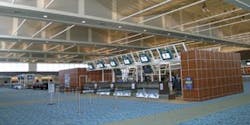
SPRINGFIELD, MO — With demand for commercial air service outpacing operational capacity, leading to longer waits in ticketing, baggage, and security, Springfield-Branson National Airport’s (SGF) 44-year old terminal has been retired from its traditional role, making way for the new $117 million Midfield Terminal. Brimming with aesthetic appeal, the new facility abandons the linear layout of its predecessor with wide-open areas designed to ease passenger navigation and enhance operational efficiency.
The airport master plan called for a new terminal complex once the airport saw a maximum capacity of 880,000 passengers; a mark attained in 2005. According to Springfield National’s director of aviation Gary Cyr, 2001 marked a shift in the type of aircraft the airport received. A terminal area study plan conducted in 1999 suggested the airport would see larger and fewer planes; yet two years later, a trend emerged contradicting the study plan.
“Commissioned by the FAA, the terminal area study plan analyzed our existing structure, inventoried everything we had, and looked at the future with a growth rate analysis,” says Cyr. “The analysis came back stating that there should be a new terminal in place in 2016.
“Counter to that, in 2001-2002, we began seeing smaller aircraft, and twice as many of them; that created a different motivation factor as the old terminal was inundated with more aircraft.”
In November 2003, the airport board, an eleven-member organization appointed by the City of Springfield, signed a contract with facilities consulting firm Reynolds, Smith & Hills for conceptual and schematic design of a new Midfield Terminal.
Out with the old
A new terminal was needed for many reasons, says Cyr, but the primary motivation was economic development. The previous facility was constricted to the point where terminal expansion would have made airport operations even less efficient. Land-locked by runways to the west and two major industrial companies to the east, a new terminal location was deemed necessary.
The former structure was long and linear; more than 1,000-feet in length. Adding to that would have been very impractical, says Cyr. “We initiated a cost-benefit analysis for modifying the old facility versus building new, and there was a 20 percent difference; we were money ahead to build new.”
Security screening of passengers and baggage also came into play. The old facility was never designed to house the type of security operations required at airports today, says Cyr. The passenger screening station was confined between the lobby and gate entrances, and baggage screening took place in small rooms once used by airline administration. The space constrictions made the ability to move passengers in and out in an efficient manner increasingly burdensome, further verifying the facility’s inadequacies.
Space was not only constricted within the terminal, but outside as well. A shortage of gates contributed to morning aircraft congestion due to an increasing number of jetliners that park at the airport overnight, relates Cyr.
Terminal Finance Plan
The finance plan was developed in 2003, and construction on the 275,000-square foot facility began in 2006. The airport borrowed $97 million in revenue bond issues, and another $20 million was attained through discretionary federal aviation funds. The total cost of the project came to $116.9 million; and the airport maintained that budget throughout the construction process, says Cyr.
“We went out for a bond issue through the public building corporation in conjunction with the city,” says Cyr. “It’s backed by our debt service plan, and ultimately backed by the City of Springfield.”
The debt service plan is conservative, explains Cyr, and comes from airport revenue, passenger facility charges, and annual Airport Improvement Program (AIP) funds. The plan strives to make annual payments that are 1.5 times the amount required. According to Cyr, even if passenger numbers drop 15 percent for 12 consecutive months, debt service can be maintained at 1.25 times.
“Payments of 1.5 times what is required means we are maintaining a 50 percent debt coverage — a very key point for the airport board,” says Cyr.
The airport board, which acts as an independent body and is appointed by the city manager and confirmed by council, signs all contracts and leases, as well as plans, develops, operates, and maintains future airport properties. The city council accepts federal grants, relates Cyr.
“So we always have half of that debt service in the bank each year, should we need that. That’s our capital improvement money, because we have entitlements tied up in the debt service passenger facility charge,” he says.
“We are an enterprise fund, which means what we generate and make here pays for operational expenses, maintenance, upkeep, and capital development.”
Leasing; servicing
According to director Cyr, the new facility is paid for by the users of the facility, whether its from hangar leases, general aviation fuel sales, car rental, parking, retail, etc.
“We have an escalating clause for landing fees, and exclusive use rents,” says Cyr. “The airlines moved from the old terminal to the new without any increase in rents, rates, or fees; they have known for three years what their rates would be for last year, this year, and next year.
“Traditionally we have owned the jet bridges, and the carriers simply lease space. We are not carrying this development on the backs of the airlines”
Springfield National offers a modified residual lease structure to airlines. Landing fees are around $1.07 per 1,000 lbs. and exclusive use space is priced at $33 per square foot.
“We have certain cost factors,” says Cyr, “and what’s remaining, the airlines combine to cover those particular costs. That’s how these facilities have operated since the late ‘40s. We strive to provide a good financial environment for the carriers to do business with us.”
Airline leases at SGF are renewed on an annual basis. Explains Cyr, “The days of three- and five-year leases have pretty much gone by the wayside. Even today, with an annual lease, airlines have been coming and going at airports across the country on a regular basis.”
Springfield-Branson also offers services to airlines that many airports do not: ground handling and fuel services.
In with the new
Construction of the Midfield Terminal was a near three-year process; the facility opened to the public on May 6. The new building currently utilizes ten gates, but is designed to provide up to 45 gates. The total site will be able to handle 60 gates by way of a satellite arm. “The facility was designed to be expanded without substantially affecting any airport operations,” says Cyr.
The great hall area of the terminal, which includes the ticket counters, baggage claim, and rental car booths, have a European airport flavor. That flavor is represented by the hall’s spaciousness and double-loaded stand-alone ticket counters.
The entire terminal, from end to end, or parking to concourse gate, is one level. Terminal designers eliminated the need for passenger stairs, elevators, or escalators in an effort to make the facilities more accessible and easier to use.
The latest technology in regards to communication and security has been installed in the new terminal. “We have created efficiencies for the TSA by installing one central screening checkpoint for passengers; it is capable of being expanded upon,” says Cyr.
“Within the electrical and climate control systems, we tried to incorporate as much of the latest most efficient technologies available to us. Building new provided the opportunity to purchase products which were more environmentally sustainable, with longer product life-cycles.”
The building’s high efficiency air conditioning uses ozone-friendly water chillers, and the air handling systems use economizers which allow 100 percent outdoor air as an alternative cooling source when temperatures are mild. Also, high performance glazing on the glass walls coupled with light roof colors minimize heat absorption.
According to Cyr, the plan was to implement common-use technologies into the new terminal, but the airlines could not be convinced to buy into the investment. “It’s a great idea, but the airlines just aren’t ready to embrace that concept,” he says. “It was really a matter of cost; incorporating that technology into our infrastructure proved costly. Without airline support, we had to back out of that option.”
The terminal features new fixed-bridge sections that are capable of extending out to the aircraft, making aircraft ramp travel more efficient. Efficiencies were also gained with the bridges themselves, and how they interface with aircraft.
Regarding concessions and retail, a debate centered on where to put what when considering pre- and post-security. Where this comes into play most, says Cyr, is factoring in how many meeters and greeters are picking up passengers from the airport. “We are an origin and destination airport, where there isn’t a lot of dwell time between flights. At most other airports, the focus is on serving post-security customers,” he says.
“But here, it’s a bit of a different situation. We have not forgotten our pre-security customer base. We have located the bar and grab-and-go food shops in post-security; we will be adding retail and a restaurant to pre-security. It’s important to look at all opportunities for revenue; with our operation, and other airports of similar size and scope, there is still plenty of opportunity for retail in the pre-security area.”
Aesthetically, three architectural themes make up the visual elements of the terminal’s construction. “To best represent the region we are located in, the three themes incorporated into the design are water, geology, and landscape; all are prevalent to our native lands here in Missouri,” says Cyr.