A Model for Sustainability
CHICAGO — Hosted by the American Association of Airport Executives (AAAE) and the Chicago Department of Aviation (DOA), the Airports Going Green Conference held here in August attracted nearly 300 attendees and exhibitors. The event offered lessons learned and best practices to airport professionals on implementing sustainable design measures and practices into civil construction projects at airports. The three-day conference kicked off with the unveiling of the new Sustainable Airport Manual (SAM), a comprehensive guide for incorporating environmentally sustainable measures into airport development planning and operation.
O’Hare International Airport (ORD) has taken a leadership role in bringing sustainable design practices to the airport setting; at O’Hare, sustainability has become common-place. From the onset of the program, all contractors associated with the O’Hare Modernization Program (OMP) have been given a sustainable design manual and been required to have LEED-accredited professionals on their teams.
LEED — Leadership in Energy and Environmental Design — is an internationally recognized green building certification system developed by the U.S. Green Building Council (USGBC), which provides third-party verification that a building or community was designed and built using environmentally sustainable strategies. All of the projects at O’Hare were designed utilizing the OMP’s Sustainable Design Manual (SDM), which has been improved upon and is now referred to as the Sustainable Airport Manual (SAM).
Says Ricondo & Associates director Gene Peters, “The SDM really did serve us well.
“We’ve implemented the [SDM] in 50 different projects across the airport. That has served us well in getting approval for environmental impact statements and the process for building the modernization program.”
The first version of the manual was introduced in 2003 and has come to be viewed as the international model for airport sustainability, according to the Chicago Department of Aviation (DOA).
Peters says the SDM was the first in many ways: the first airport sustainability guidance manual; the first to develop a rating system for evaluating projects; the first to create a green airplane certificate award system; and the first to recognize designers and contractors for sustainable accomplishments.
The updated version, the SAM, was unveiled at the Airports Going Green Conference and its purpose is to further integrate airport-specific sustainable planning and practice into the everyday functions of an airport.
Representatives from major airports worldwide contributed to the sustainable manual which expands upon sustainable airport practices with specific case studies, lessons learned, new technologies, and best practices. In collaboration with Chicago’s DOA, major airports including Paris-Charles de Gaulle, San Francisco, Seattle-Tacoma, Dallas-Fort Worth, Denver, Boston Logan, and others assisted in the development of the SAM by sharing expertise in LEED-certified terminal construction, wind energy technology, green airport vehicles, recycling efforts, and solar power installations, according to the aviation department.
Industry expertise from some 160 individual contributors including city departments, FAA, and the EPA was also included in the SAM, says Peters.
“This is a living document and it will continue to evolve,” says Peters. “This industry is changing very fast, and the technologies themselves are changing.”
Case Study: ATC Tower
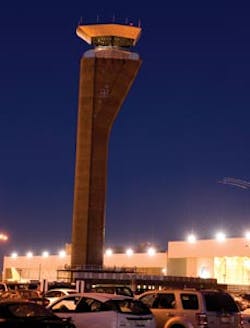
The OMP’s Khaled Naja notes that the North Air Traffic Control Tower was a unique project because it is all-encompassing. “It has the green initiative aspect; it has FAA’s critical mission aspect; and the building itself is very unique in its shape and structure,” says Naja.
The reason the ATC project was needed, relates Naja, is because both ends of the newly commissioned Runway 9L/27R could not be seen by the existing tower at O’Hare. The total cost of the tower was some $63.5 million; AECOM was hired for the design phase and the project contractor was Walsh Construction Company.
“For those of you that own and operate airports, you are the lifetime owner of these buildings and it is in your best interest to make sure your building is as efficient, and as low maintenance and low cost as it can be from the moment you build it to the moment that it may have to be replaced someday,” says Grace Rink, senior project manager for AECOM.
“If you follow the green building process, you will wind up with the most energy efficient, water efficient, and resource efficient building that you can build; and that will benefit you over the long term.”
O’Hare’s new ATC tower is currently pursuing LEED Silver certification, says Rink, but it already meets LEED certification requirements, making it the first LEED-certified ATC tower in the nation.
“Because the OMP manual really covers everything that LEED also covers, later in the construction phase when it was determined that this project was going to go for LEED certification, the OMP team really had everything underway,” says Rink.
According to Rink, a ‘green’ building needs a whole building approach for the design, construction, and operation of that building. A whole building approach is concerned with site selection, water conservation, energy use, air quality, and the use of resource efficient materials.
The new ATC tower is a sustainable site, says Rink, because alternative transportation for employees is encouraged, carpool parking spaces are allocated, open space around the tower is abundant, and the urban heat island effect is reduced with reflective concrete pavers and a 9,000-square foot green roof capping the tower’s base building.
“The urban heat island effect, which is created by blacktop roofs and asphalt parking lots, can actually raise the temperature of the city by 6-10 degrees on a hot day,” says Rink. “This increases the need for air conditioning which in turn works our power plants harder causing more air pollutants; and the cycle continues to repeat itself.
“Green roof tends to be an umbrella term that can refer to both reflective roofs and vegetated roofs; this building actually has both.” According to Rink, green roofs conserve energy and mitigate the heat island effect.
In terms of water efficiency, Rink says using native and drought-tolerant vegetation in the open spaces surrounding the tower provides a site that doesn’t require any additional irrigation systems, which saves water and also reduces the overall maintenance costs for the airport. The OMP also used low-flow fixtures, toilets, and faucets in the ATC tower and base building, achieving a 21 percent efficiency rating.
With regard to materials and resources, Rink says Chicago has a construction and demolition debris ordinance which requires that at least 50 percent of construction materials for a project are recycled. “That also meets one of the minimum requirements for LEED; this project was able to divert 82 percent of its materials from the landfill,” says Rink.
“Also, the types of materials used, such as concrete mixed with fly ash [a recycled concrete material], and using materials that come from the region, or from within 500 miles of the site, are sustainable initiatives that are not too hard to meet.”
Runway 9L/27R
The airport’s newest runway, 9L/27R, is a Group 5 Cat II/III runway designed for planes as large as a 747. The runway was commissioned on schedule and under budget last November despite a number of major projects associated with the runway construction, including creek, guard post, and water main relocations.
The Michael Baker Jr. Corporation’s program manager Bob Staiton explains that there were many challenges in building the new runway, least of which was utilizing all of the soil on site. Because the construction team’s earthwork analysis indicated an abundance of fill material, each end of the runway was raised approximately three feet to help keep the soil on site, says Staiton.
All 100 percent of the project’s excavated soil was able to be reused resulting in some 65,000 cubic yards of trench excavation used as cut and fill.
The OMP’s Jim Prosise relates that among the sustainable features of the new runway’s planning and construction, the paving contractor was required to utilize recycled asphalt from the nearby Mount Prospect Road relocation project into the paving mix for the shoulders of the runway.
Additional features include the utilization of approximately 94 percent of concrete and asphalt material from local sources; the mandated use of Ultra Low Sulfur Diesel (ULSD) fuel in all construction vehicles of greater than 50 horsepower; and the construction of on site concrete and asphalt plants to reduce traffic movements associated with the construction process, says Prosise.
Tenant Relocations: A Sustainable Approach
Due to the runway reconfiguration of the O’Hare Modernization Program (OMP), some tenant facilities required relocation. During the relocation program formulation, the OMP
included “allowances” for sustainable initiatives. Tenant negotiations included an agreement on an approach to meet sustainable design.
- FedEx Metroplex Relocation
- FedEx’s new world service center and administration facilities will pursue LEED Silver certification and will include a 10,000-square foot green roof.
- The FedEx sort building will have a 175,000-square foot green roof which will rank as one of the top 25 largest vegetated roof spaces in the world.
Enterprise Rent-a-Car Facility
- Three buildings on 3.5 acres; pursuing LEED Silver certification.
- Green roofs will be installed on two buildings.
- Stormwater design includes installation of a dry-well system.
- At least 75 percent of construction debris will be recycled.
- Installation of high-efficiency fixtures and waterless urinals.
The O’Hare Modernization Program: Additional Sustainable Initiatives
The $6.6 billion O’Hare Modernization Program (OMP) was announced in 2001 and is charged with reconfiguring the airport’s outdated intersecting runway system. The program includes the construction of a new runway, relocation and extension of existing runways, and a terminal and gate facility on the west side of the airport.
South Detention Basin
- Use of Variable Frequency Drives (VFD) on all pumps to minimize the costs associated with pumping ground and stormwater.
- Use of high-efficiency motors.
- Efficient use of on site clay soil materials as a liner system to prevent petroleum products from contaminating groundwater.
- 2.8 million cubic yards of soil managed on site; eliminated 105,000 truck movements.
- Demolished concrete was stored for use in the Runway 10L extension project.
South Airfield Lighting Control Vault
- Construction of an 18,000-square foot vegetated green roof.
- Installation of low-flow fixtures resulting in a water use reduction of 23 percent.
- More than 75 percent of construction waste diverted from landfill disposal.
- Use of low-emitting VOC (volatile organic compound) paints, adhesives, and sealants.
Runway 10L Extension
- Use of recycled crushed material and asphalt grindings.
- Use of an on site concrete batch plant.
- Usage of 240,576 tons of material purchased regionally (manufactured locally within 20 miles of the site).
- Use of lime kiln dust for soil stabilization.