The Learning Curve
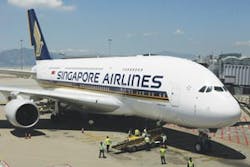
The Airbus A380-800 first took to the skies on Oct. 25, 2007, when Singapore Airlines SQ380 flew 455 passengers from its home base to Sydney, Australia.
There are now more than 200 orders for the aircraft (a stretched version, the -900 will come into service in approximately 2015) with Emirates, Singapore Airlines, Qantas and, most recently, Air France already operating the double-decker superjumbo. Despite its size, the A380 is the most environmentally friendly aircraft in commercial fleets, offering better fuel economy than most hybrid passenger vehicles and generating less than half the noise of other aircraft on takeoff.
While it has hardly become a common sight at the world’s gateways, operations are significant enough for ground handlers to have learned some important lessons.
Preparations
A lot of work was done prior to the A380’s entry into service. Airbus worked closely with the ground handling community during the design phase of the aircraft with a similar turnaround time to the Boeing 747 and minimal new ground handling equipment being the main considerations. The aircraft also made a number of validation flights to major hubs, which revealed both site-specific and universal requirements.
Around 90 percent of the equipment used for the A380 is common to other widebodies, but two new pieces were immediately identified — a 70-ton tow tractor and an upper deck catering vehicle.
The more common 50-ton tractors are compatible under some circumstances, but the stronger version is necessary during poor traction conditions or when the aircraft is at its maximum ramp weight (MRW). The catering truck, meanwhile, needed to extend over eight meters off the ground and then move horizontally to avoid contact with the wing.
The A380 design took ramp operations into account and so airfield modifications were kept to a minimum. Nevertheless, the sheer size of the aircraft, most especially its wingspan and more powerful engines, necessitated some changes. For example, although the A380 didn’t require major runway alterations, lighting and signage often needed to be re-sited to provide clearance for the wings and avoid blast damage from the engines.
At London’s Heathrow Airport — the world’s busiest international gateway and an A380 destination for Emirates, Qantas and Singapore Airlines — over £450 million ($743 million) was invested to make it A380-ready.
The main development was Terminal 3’s Pier 6. Two of its four JX (A380 size—some 20 meters wider than JW/747 size) gates operate a multi-aircraft ramp system (MARS), which are able to serve either one A380 or two aircraft up to A320 in size. Passenger holding areas at the gates are also divisible, further improving the operational flexibility of the airport and the efficiency of ground staff.
BAA also extended Terminal 3’s arrivals hall to hold new longer baggage reclaim carousels and widened taxiways to accommodate the A380’s longer wingspan. Additional airfield work includes runway resurfacing, strengthening runway shoulders and an upgrade of the lighting system.
Turnaround times
Singapore Airlines, operator of the first A380 flight, and now using the aircraft on routes to London, Paris, Sydney, Melbourne, Hong Kong and Tokyo, has significant experience in A380 operations.
Preparations for the behemoth’s arrival began years in advance of the first delivery. From 2001/2, Singapore Airlines was in regular contact with airport authorities, the discussions ranging from technical issues, such as sufficiently proportioned parking bays and runways, to customer service issues such as larger boarding lounges.
“Ground handlers operating our A380s have had to acquire new equipment to handle the aircraft effectively, such as longer baggage carousels and direct upper deck-access catering trucks,” confirms Nicholas Ionides, vice president of public affairs. “Passenger handling procedures, such as boarding sequences and signage to facilitate boarding, have also had to be reviewed in view of the larger capacity of the A380.”
The airline conducted a multitude of tests with its ground handlers at various airports to ensure it was able to maintain a turnaround time of 120 minutes — the standard for the Boeing B747-400. “In fact, we have an internal target lower than that, and we have mostly been able to keep it under this target,” reveals Ionides.
Intensive training across various areas formed another major part of preparation for the superjumbo. Cabin crew had to undergo a four-day conversion training course for the A380, covering safety, service, product offerings and aircraft familiarization. Those selected to operate the Singapore Airlines suites also had to undergo an additional day of training. At the same time, operational procedures were reviewed to improve efficiency in view of the higher passenger numbers.
Although Ionidies accepts there will be hiccups with all new aircraft being entered into service, he stresses the airline has worked closely with Airbus, vendors and all stakeholders to ensure that the problems have been reduced to a minimum.
“We already have 10 A380s in our fleet and we have been happy with the dispatch reliability, given that the aircraft are being operated within very tight schedules, and at a high daily utilization rate of more than 13 hours,” concludes the VP of public affairs. “We are consistently gathering feedback from our crews and ground handlers, and we are confident of maintaining consistently high standards as the A380 fleet increases.”
Dubai — home of the A380
Of course, nobody’s A380 fleet will increase quite like that of Emirates airline. The Dubai-based carrier has ordered no fewer than 58 of the aircraft, with services to Seoul the most recent addition to the A380 network. Bangkok, Toronto, London and a service to Sydney and Auckland also benefit from the A380.
Testing at Dubai began in 2007, with the notoriously fierce heat of the Middle Eastern summer a significant component in all trials. Emirates even had 517 volunteer passengers going through all pre-flight formalities. Everything from self-service kiosks to remote stand boarding using 10 50-seater buses was put through its paces. The airline scheduled a two-hour turnaround between test flights for ground crew to test their operations. Emirates Flight Catering loaded food trolleys using a special A380 hi-loader, all ground support equipment was deployed, and passengers were even deplaned and then re-boarded.
Subsequently, the carrier’s ground support division, Dnata, invested in a number of areas, including doubling the number of ground power, air conditioning and air starter units.
Despite handling the A380 for over a year, Dnata is constantly reviewing its processes and says the learning curve is still there. However, it is already involved in consultative work on the A380, ensuring outstations due to receive the aircraft are at the requisite quality levels.
Quality isn’t a problem for Emirates’ home terminal at Dubai, which is a new construction built with the A380 in mind. Another new facility — Dubai World Central-Al Maktoum International — will be similarly equipped to handle this next generation aircraft. HH Sheikh Ahmed bin Saeed Al Maktoum, president of the Department of Civil Aviation and chairman of the Emirates Group, has said he is looking to create nothing less than the most advanced aviation hub in the world.
Turning up down under
Qantas A380 operations have had a bumpier ride, including the grounding of the aircraft in March due to technical issues.
Its home bases of Sydney and Melbourne are well-prepared for the aircraft — benefiting not only Qantas but also the majority of A380 customers, some 75 percent of which are expected to use the plane on Australian routes. Singapore Airlines already flies there, Emirates will begin A380 services in 2010 and carriers such as Etihad and Qatar Airways also plan to put the superjumbo on services down under.
Mark Lewis, who was Qantas project manager for A380 Airport Readiness, says comprehensive preparation and planning took place over several years. “Of the issues that had to be managed, a consistent one was aerobridge operation,” he says. “Each A380 bay at each terminal has a unique configuration, which required considerable effort in identifying appropriate controls to address potential conflicts between aerobridges, and between aerobridge and aircraft.”
However, the aircraft’s presence at inaugural destination, Los Angeles International (LAX), hasn’t been universally welcomed. Earlier in the year it was reported that only the huge slump in traffic as a result of the economic downturn prevented a tarmac gridlock when the A380 was in town. The aircraft’s requirements force a number of operational restrictions, and the concern is this will cause severe congestion at LAX as traffic levels return.
Lewis admits ground handling procedures have had to change as a result of introducing an all-new aircraft like the A380. “These will no doubt evolve further as we become more experienced in handling the aircraft under varying conditions, including managing multiple aircraft,” he says.
The introduction of multiple overlapping schedules has already had some impact on training and rostering, but Lewis says Qantas has been very successful in managing these. “At each of our A380 destinations, the GSE procured to service the aircraft was selected to be scalable to an increasing A380 fleet size,” he reveals. “We are confident that the introductions of more Qantas A380s will not cause any additional complexity or risk to the ground handling operations.”
According to Lewis, the one challenge for all A380 carriers is the preparation of sufficient alternate ports to turnaround the A380 in the event of a diversion. This may involve investment by ground handlers to ensure the future-proofing of their equipment.