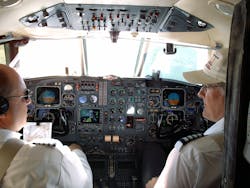
Test flights have been a fact of life in our industry since that fateful day at Kitty Hawk and are undertaken for a variety of reasons. In some cases they are mandated in the event of engine overhaul or required as part of a manufacturer’s ongoing maintenance program. The Federal Aviation Administration (FAA) provides little guidance on the topic with many of the crucial decisions left up to those involved in the event.
Federal Aviation Regulations (FAR) contained in Part 91 include statements implying all equipment on board an aircraft must be functional for flight or otherwise listed in a minimum equipment list (MEL). It is also stated that it is the responsibility of the pilot in command to ascertain the airworthiness of the aircraft and whether it is in a condition that is safe for flight.
The concept of flying an aircraft with a known anomaly, be it intermittent or otherwise, may be a bit of a stretch for those of us with an awareness of the regulations. A damaged aircraft is defined as one that has sustained physical damage, has inoperative/malfunctioning equipment, does not meet applicable airworthiness requirements, and as such will require a “Special Flight Permit” from the local airworthiness authority. This consideration is often overlooked when maintenance test flights are needed.
One of my realizations over the years is that most aircraft are inhabited by gremlins. Many reside in the landing gear wheel wells. When the aircraft is on the ground with the gear extended, these critters are comfortably at rest. Once a flight is initiated and the landing rear is retracted into the wells these insatiable little rascals are forced from their homes and in a fit of rage will frequently wreak havoc with many of the aircraft’s systems.
Troubleshooting techniques employed today include the shotgun approach, involving replacing virtually all the components that in and of themselves or combined with others, may produce the symptoms at hand. There is also the analytical approach which involves technical knowledge along with a logical thought process. Generally when a flight test is required it means there are no more parts to throw at the problem and no definitive abnormalities have been detected from at least a basic level of diagnostic techniques.
Have an objective and a checklist
As test flights can be both expensive and risky, a well-conceived plan should be created prior to the flight. The first determination should be the objective of the flight: will it involve only observations or will diagnostic actions be implemented? If so, a checklist should be created and reviewed by all parties involved. This should include considering the problem at hand and any possible conflict with aircraft limitations.
Assignment of crew member duties is integral to the success of any flight. One crew member should be tasked with flying the aircraft while a second pilot can assist with various flight deck selections to facilitate the required checks. Crew duties can vary depending on the qualifications of the technician accompanying the flight along with the airframe stipulation for minimum required flight crew.
Having participated in numerous airborne system evaluations in aircraft requiring two pilots it is my rule to never reach into the flight deck but to request the pilot not flying to make the needed control selections. As an example: if the discrepancy involves an auto flight system that could cause aerodynamic instability at high speed or high altitude, consideration should be given on how to proceed without putting the aircraft at risk. Some airframe manufacturers recommend using factory test pilots to conduct maneuvers or handle situations where the aircraft may be required to operate outside the normal performance envelope.
One of the first decisions should be exactly where the testing maneuvers will be accomplished. It may not be prudent to test an autopilot stability issue in an area of known turbulence or troubleshoot a magnetic compass problem in the Bermuda Triangle.
Another pre-departure discussion should involve the reactionary steps to be accomplished should the anomaly occur. The flight crew should be thoroughly briefed on what to expect and the order of steps to obtain the desired information.
In-flight diagnostics
Auto flight system issues are some of more challenging problems to resolve as ground testing can not simulate the effects of aerodynamic loads and airframe abnormalities. Recent technological advancements provide for high level maintenance diagnostics that can provide useful information in uncovering various malfunctions. In some cases diagnostic data can be retrieved or at least observed while in flight. Observation of flight deck indications along with awareness of what else is happening within the aircraft will often provide clues critical to problem resolution. Auto pilot disconnect, wing walking, and porpoise are some commonly reported discrepancies with numerous possible causes.
Aircraft speed, altitude, atmospheric conditions along with operation of peripheral systems such as telecommunications, WiFi, radio communications, and even lighting can be contributing factors to auto flight issues.
One example of observation providing a valuable clue to an auto pilot problem has to do with a report of an auto pilot disconnect at altitudes below 10,000 feet. Once the aircraft was on the ground the problem could not be duplicated. The aircraft was returned to service and flew two missions before the exact same problem reoccurred.
Again the maintenance investigation failed to reveal a smoking gun. As a precaution the auto pilot computer and an air data computer were replaced. After departure on the very next flight the crew could not get the auto pilot to engage. They did continue the flight and when level in cruise at FL330 they were able to get the auto pilot to come on line and it functioned flawlessly for the duration of the flight. After repeated ground testing and swapping of parts, it was finally decided that a test flight was needed.
The technician riding in the jump seat was instructed to be observant as the crew put the aircraft through a series of maneuvers. Everything went well and the auto pilot performed as it should throughout the flight and into the decent. Just as the aircraft descended through 10,000 feet the copilot reached for and actuated the switch illuminating exterior pulse lights. This was a common but not standard practice. Moments after the pulse lights began to function, the auto pilot disconnected and would not reengage. Once the switch was returned to the off position the autopilot was able to be reengaged and worked without incident. This phenomenon was later duplicated on the ground. The pulse light control box was replaced, electrical bonding was reinforced, and the problem, attributed to electro magnetic interference (EMI), never resurfaced.
Another example illustrating the value of a well-orchestrated test flight involved an autopilot slow oscillation about the roll axis. The initial maintenance actions were per the book and involved checking the autopilot servo along with cable tensions. The flight crew had been briefed on how to select various flight modes and substitute sensors. When nothing made a difference, a test flight was scheduled and resulted in the technician observing excessive movement of the turn and slip indicator during auto pilot commanded turns. This observation led technicians to finding a non-responsive yaw damper.
Test flights will no doubt continue to be a necessity even with the most sophisticated diagnostic systems and the key to success is effective planning. The utmost importance is thorough system knowledge, a pertinent script of the tests to accomplish, record keeping, and communication between all participants.
I have also learned that care and nurturing of gremlins will often lead to a less stressful workday.
Jim Sparks has been in aviation for 30 years and is a licensed A&P. His career began in general aviation as a mechanic, electrician, and avionics technician. Currently when not writing for AMT, he is the manager of aviation maintenance for a private company with a fleet including light single engine aircraft, helicopters, and several types of business jets. You can reach him at [email protected].
About the Author
 Jim Sparks
Jim Sparks
Jim Sparks has been maintaining aircraft for almost 40 years with the majority of the time involving Business Aviation activities. Jim’s endeavors have placed him on six of the seven continents contending with numerous situations from routine flight dispatch to critical AOGs. His career includes maintainer, avionics/electrician, educator, tech rep, and director of aircraft maintenance. In addition to other activities he is engaged with ASTM assisting in the global development of criteria defining the Next Tech for NEXTGEN. You can reach him at [email protected].