Aircraft Batteries
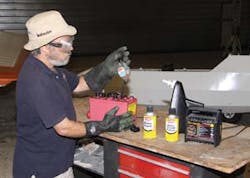
Like car batteries, aircraft batteries serve to start the engines or the APU. But the comparison stops there as aircraft are required to do much more. In-flight electrical generation failure is an emergency that calls on the batteries to power the essential loads until landing and evacuation. They have even been used to restart the engines after the rare cases of engine flame-out. They also act as a buffer regulating the DC network voltage ensuring acceptable power quality for the equipment connected to it. As these various functions attest, aircraft batteries are crucial components and deserve to be treated and maintained with care.
Battery technology and construction
Two chemistries are generally used for today’s aircraft batteries — nickel cadmium (Ni-Cd) and lead-acid. Lead-acid batteries are either vented or valve regulated (VRLA), and are typically used in light and general aviation aircraft. At the other end of the spectrum, vented Ni-Cd batteries dominate larger aircraft and helicopter applications while both VRLA and Ni-Cd types are found in smaller aircraft such as business jets.
Nickel cadmium (Ni-Cd)
Ni-Cd cells contain interleaved electrodes connected via internal current collectors to terminals that pass through the cell cover. Between the electrodes, a non-woven polyamide felt separator keeps the alkaline electrolyte in contact with the active surface. It prevents short circuits while allowing current flow through the electrolyte. The separator system includes an oxygen barrier made of organic or micro-porous synthetic material. During overcharge, this barrier minimizes oxygen recombination to ensure low and stable overcharge current.
The electrode assembly is housed in a rigid plastic container that allows cells to be fitted side-by-side in a battery case. Each cell is equipped with a low pressure vent valve that can be removed to allow water addition. The vent allows gas produced in normal operation to be released while preventing electrolyte from escaping and contaminants from entering. Ni-Cd aircraft batteries usually consist of a metal box containing 20 individual series-cells connected using rigid, highly conductive, nickel-plated copper cell links that are secured by nickel-plated copper nuts on the cell terminals.
Lead-acid
Lead-acid batteries use one 12-cell or two 6-cell plastic containers to house individual cells that are series-connected through the cell wall to give a nominal voltage of 24 volts. This provides a ‘mono-bloc’ structure where the cells cannot be individually removed or checked.
Inter-electrode separation is assured by the use of polymeric or glass-fiber mats that maintain the sulphuric acid electrolyte in contact with the active surface. The main difference between vented and VRLA batteries is the use of higher pressure valves and different separators that, in VRLA, are designed to promote oxygen transfer to maximize oxygen recombination.
Mechanism of failure
Over time, all batteries eventually lose their ability to perform and become eligible for scrap and recycling.
In Ni-Cd batteries the three main mechanisms of failure are all progressive and can therefore be predicted in advance, with high reliability, through proper maintenance. They include oxygen barrier failure, separator failure, and irreversible capacity loss due to degradation of active materials.
The principle mechanisms of failure in lead-acid include capacity loss due to active material degradation, loss of the active material from the current collecting structure leading to high internal resistance, and corrosion of the current collecting structure leading to sudden death. In contrast to Ni-Cd batteries, high internal resistance and corrosion can appear rapidly and without warning especially if the battery has been subject to deep discharge, for example during ground operation. Unfortunately these mechanisms of failure are not detectable during maintenance checks.
All battery technologies can experience the phenomenon of thermal runaway. It occurs when heat generation exceeds heat dissipation causing a temperature rise that leads to even more heat generation. This can occur in intensive use when insufficient time is available for cooling after battery starts. It can also occur due to separator failure or drying out of cells, but, in the case of Ni-Cd, is avoided if maintenance is correctly performed. As a precaution, Ni-Cd batteries are usually fitted with temperature sensors which detect a potential thermal runaway and allow the battery to be disconnected.
Generally speaking, the life of vented Ni-Cd batteries is seven to nine years on long-range aircraft, five to seven years for regional and commuter aircraft and 10 to 12 years for business jets. By comparison, the life of lead-acid batteries is one-half to one-third that of Ni-Cd and can be greatly reduced by high temperature operation.
Battery maintenance
All battery technologies require scheduled checks to ensure safety. Maintenance ensures optimum performance and avoids on-board failure that leads to costly delays for operators. Ensuring the performance of a battery is especially important when the battery is used for internal starts. More than 85 percent of the life of a turbine is used up during the engine light-off sequence due to the high temperatures generated. The longer the engine takes to start, the higher the temperatures are, and the greater is the wear and damage to parts.
Battery maintenance is performed off aircraft in dedicated battery shops that can be found all around the world and are usually either owned by the operator or by specialist distributors. It is mandatory that they be authorized by the local airworthiness authorities and they can also seek optional approvals by battery manufacturers.
Basic maintenance procedures are similar for both lead acid and Ni-Cd. Apart from the usual tools such as torque wrenches and multimeters, equipment is required to charge and discharge the batteries. Vented batteries also require means to adjust electrolyte levels and check cell vents. Specific to Ni-Cd are the means to deeply discharge individual cells in order to erase any cell imbalance. Various specialist manufacturers offer proprietary systems that can accomplish these tasks with the minimum of labor.
Maintenance intervals are defined by the aircraft manufacturer based on battery manufacturers’ recommendations in relation to the particular aircraft and its usage.
The basis for determining maintenance intervals depends on the energy required for emergency requirements and the electrolyte reserve of the cell. Important factors influencing the interval include the battery charging system, battery operating temperature, type of starting, number of starts, flight duration, ground operation, and the battery technology.
Future of aircraft batteries
The need for more advanced battery technology is being driven by the requirements of weight reduction and more electric aircraft. The ‘electrification’ of functions that were previously powered hydraulically, like actuation, requires high voltage architectures.
As of today, only the higher voltage associated with lithium-ion can provide an appropriate solution to this change. In light of this, cutting-edge Li-ion battery systems which meet these new requirements are being developed.
Li-ion is a sensitive electrochemistry which needs a detailed knowledge of its characteristics to allow its benefits to be exploited fully while ensuring maximum safety. We are likely to see continuing improvements in Li-ion performance as new electrode materials and electrolyte compositions are already under study. Nano-materials now being developed will also have a role to play. Nevertheless, Li-ion batteries are not currently envisaged as retrofit solutions so Ni-Cd and lead-acid batteries still have many years of work ahead of them. AMT
Dr. Nigel Thomas has a Ph.D. in chemistry from the University of London and has worked on the technical side of the battery business for 35 years, more than 25 of which have been spent with Saft. For the last 10 years he has been Saft’s main technical specialist for aircraft batteries, providing support to operators and OEMs developing new aircraft. He can be reached at [email protected] or +33 1 49 93 18 28.