
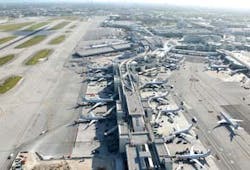
MIAMI — Since the late 1990s, Miami International Airport’s capital improvement program (CIP) has been one of the largest redevelopment efforts underway at a U.S. airport. With the completion of a fourth runway, the development of two passenger terminals, and the realization of an aggressive cargo facility development program, the gateway airport’s CIP has encompassed all aspects of airport operations. Now, as officials gear up for the culmination of the decade-long plus program, director José Abreu sits with AIRPORT BUSINESS to discuss the challenges involved.
The primary objectives for MIA’s multi-year capital improvement program (CIP), as laid out by the Miami-Dade Board of County Commissioners (BCC) are as follows:
• Enhance efficiency and safety;
• Reduce delays;
• Maximize non-aeronautical revenues;
• Modernize the facilities;
• Support the needs of airline carriers;
• Increase air cargo activity;
• Accommodate changes in the aircraft fleet mix;
• And to complete a multitude of infrastructure and environmental support projects at Miami International and the general aviation airports within the Miami-Dade Aviation System.
Handling more than 33 million passengers and two million tons of cargo annually, MIA is among the nation’s busiest international and cargo airports, and continues to be Florida’s leading international gateway, handling some 70 percent of the state’s arrivals from abroad — more than all the other airports in Florida combined.
Often touted as Latin America’s gateway to the U.S., MIA’s redevelopment was necessary to accommodate the airport’s forecasted passenger and cargo growth, explains Abreu, director of both Miami International and the Miami-Dade Aviation Department.
Among projects completed and in use, the field’s fourth runway, an 8,600-foot strip completed in 2003, increased MIA’s airfield capacity by 25 percent, “A huge improvement,” in terms of reducing the cost of delays, relates Abreu. The airport’s newest passenger terminals, of which one is complete (South Terminal) and the other nearing completion (North Terminal), add more than 4 million square feet of space to MIA’s original 3.5 million square feet.
The airport’s cargo facility development program has also been completed, adding more than 2.7 million square feet in 17 new buildings. Additional completions include several new taxiways, expanded parking, a central collection plaza, additional lanes at the upper and lower terminal drives, subsurface utilities infrastructure, and a new international general aviation center.
According to Abreu, the airport’s construction payout for 2009 averaged more than $40 million per month, employing some 1,400 construction workers. Still in development are portions of the North Terminal and an elevated people mover system, aptly dubbed the MIA Mover. The MIA Mover will connect the airport to a consolidated rental car facility, the first major component of the Florida Department of Transportation’s Miami Intermodal Center (MIC).
An advantage to managing such a large development program is Abreu’s background as a licensed professional engineer and certified engineering contractor. Prior to his appointment as aviation director in 2005, Abreu served as secretary of the Florida Department of Transportation (FDOT) under Jeb Bush. In that capacity, he oversaw all FDOT operations, including seven districts and the Florida Turnpike Enterprise encompassing 7,500 employees and an annual budget of $9 billion.
Remarks Abreu, “I think the leaders in this area realized that the critical path of this airport was the CIP. There’s nothing worse than having a long-term debt and nothing to show for it. So they said … let’s try an engineer for a change.
“Frankly, I think what got me this job was the fact that I worked 21 years with FDOT; if you look at the work program in a given year for FDOT, this CIP is actually larger than all of the state’s construction put together, which I used to oversee.”
The South Terminal
Opened in 2007, MIA’s $1.1 billion South Terminal is a 1.7 million-square foot facility that exhibits sleek architectural designs incorporating vaulted ceilings, tall windows, natural lighting, and an impressive collection of Florida-themed artwork coordinated by Miami-Dade County’s Art in Public Places (APP) Department (1.5 percent of all new county construction is awarded to APP).
The terminal features a new 15-gate Concourse J and a renovated 13-gate Concourse H that serve 20 domestic and international airlines.
The facility boasts some 59,000 square feet of concession space, including an 8,900 square foot food pavilion and a 1,000 foot long concession hall for 61 dining, retail, and duty-free stores. In terms of location, “90 percent of our concessions are situated post-security in both the North and South Terminals,” says Abreu.
With regard to security, the South Terminal houses a new Federal Inspection Service area that can process 2,000 international passengers per hour, and a new baggage screening system with four miles of conveyor belts that can screen and transport 4,000 bags per hour, relates Abreu.
The check-in area features 168 ticket counters and some 1,000 feet of new curbside drop-off and pick-up space. A new cruise and tour bus station can also be found in the South Terminal, with 22 airline ticket counters for shuttle service to and from the Port of Miami.
The North Terminal
Still under construction, the $2.8 billion North Terminal has had a convoluted history, says Abreu. It was conceived around 1996 and was overseen by American Airlines originally. The North Terminal is dedicated entirely to American and its oneworld alliance partners.
“American has the biggest market share at MIA by far; along with American Eagle [a regional affiliate of AA] it has close to 70 percent market share,” explains Abreu. “For various reasons, in 2005 ... two weeks before I arrived, the county assumed control. We had to do a constructability review and finish the plans, which weren’t even 30 percent complete.”
Abreu describes building the North Terminal as akin to re-tiling a bathroom while taking a shower. “I made a tough decision, totally as a civil engineer and not as an airport director, to close concourse A [16 gates], which was our newest concourse back then, because it was really tough to maintain the traffic from concourse A to the baggage claim area while also constructing the terminal,” he says.
“The corridor for domestic passengers in between the baggage claim and Concourse A would have to have been moved completely during the time of construction a total of 24 times; a total of 60 times if you count the modifications on either end — just to facilitate the efficient movement of passengers.
“We would’ve been moving hallways for a net time span of two years; when would we have time to build the rest of this thing?”
Adds Abreu, “That decision saved us two to three years and $200-300 million.”
When asked why the decision was made to expand as opposed to build new, Abreu relates, “It was evident that American had a large share of the business here, and if you look at the airport, 40 percent of the total traffic at MIA is connecting. So the North Terminal’s position in the airfield was absolutely paramount ... and the fact that the hangar where American does its maintenance needed to be close by played a role in the decision as well.”
The airport was designed in the 1950s. The concourses (A-G) emulated a hand’s fingers — and operators could only push or pull one aircraft at a time in the spaces between the concourses, explains Abreu. “Now with four runways, we have an airfield capacity for more than 70 million passengers; the idea was to get rid of concourses B and C, and position A-D in a linear fashion, add a set of dual taxiways, and have the ability to pull 20 aircraft at once without interfering with aircraft leaving the gate area.
“So it’s all about how many times you turn a gate as opposed to having more gates; the concept was conceived in order to facilitate connections.
“On average right now, American turns their gates four and a half times per day; if they had to, they could turn a gate ten times per day — so that’s the name of that game.”
American has made a commitment to Miami, comments Abreu. “This is its Caribbean and Latin American hub; we are one of its biggest hubs, second only to Dallas. We are also the second largest gateway to the nation for international traffic, behind only JFK.”
Phase 1 of the North Terminal construction is now complete. American is utilizing a 290,000-square foot area that features 58 ticket agent positions, 66 self-service check-in devices, 14 curbside check-in positions, and two new security checkpoints. Phase 2, scheduled to open this fall and next spring, will include 25 new or renovated passenger gates, American Eagle’s new two-gate Regional Commuter Facility, a one-mile long four-station people mover (the North Terminal SkyTrain) capable of transporting 9,000 passengers per hour, and a state-of-the-art baggage screening and delivery system.
The entire North Terminal is scheduled for completion in the fall of 2011. Remarks Abreu, “When complete, the North Terminal will be a 50-gate super hub with the capacity to serve more than 30 million passengers per year.”
Security, Baggage
“As a gateway to the nation, we require additional cost and effort with regard to infrastructure because of the sterile area leading to Federal Inspection,” says Abreu. “The North Terminal was no exception.
“For example, Orlando has almost the same amount of traffic, yet its international traffic is less than 10 percent of its total traffic; we’re about 50/50. Our gates need to be both domestic and international; the international gate has to have additional infrastructure to keep it sterile — this amounts to an additional floor for the entire terminal.
“With the exception of concourse G, all of our gates are convertible to be domestic or international; we have built in that flexibility.”
In addition to the added level of security, the baggage handling system in the North Terminal is “probably the most sophisticated in the world,” relates Abreu.
“It’s a gate delivery system — in other words, a bag doesn’t go to a cart where someone will deliver it to the gate; it’s an in-line baggage system that delivers bags from the ticket counter directly to its respective gate.”
The gate delivery baggage system cost $202 million and includes ten miles of conveyor belt, he says. The North Terminal is a mile in length and includes 50 gates; the baggage delivery system features 25 in-line explosive detection system machines and will have the capacity to screen and transport 8,400 bags per hour.
“Because we are a highly international airport and we have layovers during certain hours of the day where we have peaks to South America or Europe, we also have an entire room dedicated to early baggage storage,” says Abreu. “The system automatically knows where to store the bags, and it will know if a connection is missed … it identifies the first available flight to that destination and sends the bag there; the system is completely automated.
Managing the Project
Comments Abreu, “There is no such thing as a perfect set of plans; imagine trying to work this terminal with only 30 percent of the plan complete; that’s how I inherited this project.
“You have got to plan the work before you work the plan. We tried to spread the work around; we had some 49 different contractors in tying one area to another; inefficiencies were everywhere when I took over.”
In addition, says Abreu, all of the contracts were time and material … “In other words, the county would only pay time and material, so where was the incentive to finish the project?” asks Abreu.
“We are the contractor, but at least within the current contracts, different annexes were negotiated lump sum as opposed to time and material. With that, I could get a handle on how much I will end up paying as opposed to not knowing until the end of the month when the bill is sent; that was a change that needed to be made.
“The community has also helped a lot. Miami-Dade may have a reputation of being highly diverse with a good amount of varying interests, but if there is one administrator in this County that has been almost if not entirely supported in this project, it has been me.
“For example, the county passed an ordinance for the North Terminal that allows me the flexibility to change things contractually or otherwise, as long as I don’t go over budget without having to go to the Board of County Commissioners; the County gives me that freedom.”
MIA utilizes a residual airfield and terminal lease structure, relates Abreu. All of the common gates have an equalized rate, meaning, “No matter where you are at the airport, the rates are equal; you will not pay more because you’re in a newer terminal,” says Abreu.
“That’s something we may revisit; right now everything is in flux and this model has served us well throughout the construction period.”
The funding for the CIP is backed by aviation revenue bonds, says Abreu. “We have been able to maintain an A rating among the three ratings agencies,” he adds. “In fact, Fitch upgraded our outlook a few months back from negative to stable; out of 33 airports that went to market between June 6 and December 2009, 24 received a downgraded outlook ... and we went the other way.
“There are a couple reasons for that — our traffic is steady and the alternative minimum tax waiver under the stimulus package has provided considerable relief.”
Cargo city
“We are on some 3,300 acres and we have an entire cargo city,” relates Abreu. “We are the number one international freight airport in the nation.
“The trade we do with Brazil here is huge, some $13 billion per year. I asked an official there, why Miami? He answered, because you’re so close to the United States!”
MIA’s top trade partners by weight also include Columbia, Chile, Peru, Equador, and Argentina. In January 2010, the airport’s leading cargo airline was Arrow Air, with 14 percent of the market share, based on total freight tonnage.
The airport is now contemplating a new development for Centurion Air Cargo, which is planning to transform a parcel of land into an air cargo hub, he says.
“The infrastructure here is great; four runways and a cargo city … but I think what makes us special in the cargo area is the privately owned freight-forward industry located all around the airport,” he explains.
Apron space for cargo has grown to over 3.8 million square feet, with 41 common-use cargo positions and 23 leased cargo positions.
After finishing 2009 on an upward trend in both passenger and cargo volumes, MIA had an increase of 25 percent in freight for the first quarter of 2010. Through March, MIA handled 427.7 tons of international freight and some 55 tons of domestic freight in the first quarter.