Harnessing the digital revolution
BRUSSELS — The focus at the 2010 Air Transport IT Summit held here in Belgium in June was well-conveyed by the conference theme: The Next Digital Decade. Amidst heavy tech-talk of emerging innovations, Web-based practices, and the widespread acceptance and adoption of mobile electronic technology ... there was also a profound call for industrywide stakeholder integration. As Paul Griffiths of Dubai Airports expressed, “Silos have carved up the travel experience. We need to change the mindset and the industry model.”
Managed and hosted by SITA, specialists in air transport communications and IT (information technology) solutions, and co-hosted by Airline Business magazine, the air transport industry (ATI) IT summit features high-level presentations given by tech specialists at both airlines and airports from around the globe.
British Airways (BA) CIO Paul Coby opened the conference with encouraging remarks about the state of the industry, commenting, “As we look ahead to the new decade there are promising signs of recovery for air transport; traffic volumes are now rising ... there is no denying that the recovery is happening.” But, he adds, “There’s no denying that within the last year we’ve faced unprecedented challenges as an industry.”
Now, the air transport industry is looking to address those challenges with an emphasis on utilizing technology to increase operational efficiency, maximize revenues, and optimize the customer experience.
SITA asks, “As we plan for the upturn, how can airlines, airports, and other industry stakeholders build their IT strategies to chart the course ahead?” The 2010 Air Transport IT Summit proved an appropriate forum for discussing just that. With more than 300 delegates from around the world in attendance according to SITA, the summit provided a robust mixture of insight from forward-thinking industry professionals.
Speakers at the conference included Cathay Pacific Airways chief executive Tony Tyler, who candidly addressed the issue of IT distribution, and the challenge of giving customers the technology they expect; Delta Air Line IT infrastructure director Jay Fredericks discussed the role IT continues to play in the Delta/Northwest merger; and research analyst Henry Harteveldt defines who today’s digital traveler really is.
On the airport side, Dubai Airport CEO Paul Griffiths speaks to the air travel process as a whole, and why it should be redesigned to recognize the individual needs of the customer; Abu Dhabi Airport Company’s Michael Ibbotson relates how technology is planned for implementation at what is expected to be one of the world’s most innovative and leading edge passenger terminals; and LAWA’s (Los Angeles World Airports) CIO Dominic Nessi gives his vision for what the airline passenger will look like a decade from now.
Airline Perspectives; Lessons learned
Says Air France-KLM CEO Peirre-Henri Gourgeon, “The effects of the economic upturn were multiplied by two or three for the airline industry ... and even if recovery could be significant, what we know is that our margins continue to be largely insufficient for creating added value. So cost cutting measures and chances to grow are sort of going to be priorities.”
Regarding consolidation, Gourgeon says it will be a keyword as the industry moves forward. “We have more than 100 airlines competing all over the world; in our business it is very difficult because we cannot refrain when we have one seat ready to fly at half the cost ... it is always better to get some money for this flight seat than not having any money [for it].
Along the same lines, Jay Fredericks, managing director of IT infrastructure and operations for Delta Air Lines, brings a different perspective from a specific airline merger, Delta/Northwest.
“At this stage of the merger,” he says, “We have a single operating certificate and have rebranded some 250 airports worldwide. There is common livery on almost all of the fleet, a unified employee group, a single network marketing presence, and we have delivered about $1billion per year in ongoing savings [merger synergies] out of a target of $2 billion through the merger.”
In terms of IT, Fredericks says the project was divided into more than 3,400 individual milestones that had to be met over a two-year merger plan. That broke down into 269 implementations and six major events, of which the carrier is about 85 percent through currently.
The standard portfolio approach wasn’t working, relates Fredericks. Delta created a centralized IT organization and portfolios that liaisoned with individual business groups.
“That portfolio approach wasn’t enough to get us where we needed to go,” he says. “What we found was we had to have cross-functional teams — this was a huge success to our merger. Instead of focusing on the individual applications and business requirements, we focused on the six major events.
“We’ve created enterprise working groups that go across natural airline processes. Senior business executives and IT leaders come together to strategize and prioritize projects across divisions,” which helps facilitate a service-oriented approach to how IT is done, explains Fredericks.
Going forward, the goal is to pursue standard solutions and commodity products wherever possible; adapt business processes to products versus vice versa; and to leverage consumer technology to be cutting edge [think iPad kiosks, etc.], he relates.
The IT revolution and the digital traveler
BA’s Paul Coby, responsible for technology, property, financial shared services, and continuous improvement across the airline, says IT has revolutionized the air transport industry over the past decade.
“We are the most online industry there is; more than 65 percent of travel is booked online today — online is now the mainline for our customers,” remarks Coby.
“What will air transport look like in 2020? We figure seven billion passengers will pass through our airports each year; 15,000 aircraft will fly the skies; and we will have 1.56 billion arrivals as international tourism burgeons — a 77 percent increase over today.”
Coby also predicts a 23-fold increase in mobile, voice, and data traffic, and some five billion Internet users (compared to approximately 2 billion now); and every traveler will have a digital identity. He makes what he calls ‘four C-bets” for the next decade:
Cloud computing — “We are moving into the cloud now,” says Coby. “New computing architecture will be massively scaleable, virtualized, and massively cheaper, supporting a vast number of IT-enabled applications.”
Consumerization — Or what Coby describes as: everyone connected, anywhere, anytime, with everything. He comments, “Customers expect airlines to contact them in disruption with a solution already identified; and our workforce will expect new tools to do their jobs ... they will want the capability to work on an aircraft with the actual manual on a heads-up display or next to them on digital devices.”
Convergence — Where the Internet of things meets the Internet of mobility, relates Coby. Three pieces of technology are at last coming together, he says. “One, the measurement and interconnection of everything [there will be one trillion Internet connected devices next year]; two, application-rich and location aware mobile devices; and three, web-based services.
“This will enable step-changes in efficiency ... knowing where everything is and having the ability to access it allows the capability to take information out of the silos and putting it together to optimize operational processes and identify problems before they occur.
Consolidation — Or the growth of IT super-giants. Increasingly, says Coby, IT and air transport looks rather different. “Other industries are dominated by the super-giants of IT such as IBM, HP, Microsoft, SAP, Oracle, and Cisco; giants are becoming virtually integrated.
“The opportunity for the air transport industry is to use partners like SITA to keep control of our own destiny, and to keep the ability to deal with our own customers. Why should ATI work together on IT?
“We are so interconnected … we need to work to common standards using new technology; we need to cooperate on the standards and compete like mad for the passenger and cargo at the other level.
“IT is changing the way the world works, again; it’s a game changer for all consumer and customer-focused industries like ours. You have to understand this stuff, and if you don’t, your competitors will and they’ll eat you for breakfast.”
Henry Harteveldt, vice president and principle analyst for Forrester Research, was named one of the 33 most influential people in the travel industry by Travel Weekly Magazine in 2007. According to his research, the U.S. is the only country right now where there are more people who say they fly for business purposes than leisure.
“We see in Europe what’s going on with some of the austerity measures, and I think this cannot be good for the travel and tourism industries,” remarks Harteveldt.
“We all have to be keenly aware of what this means if people have later retirement ages, potentially less holiday time, less disposable income, and so on. We really have to monitor this.”
What it means, he says, is “If you’re a carrier in a developed nation, you need to prepare for a shift in the passenger base. You will have to serve more leisure passengers who will be older than you are. They will want more circuitous shopping paths that allow them to shop by different things than simply origin and destination.
“They’ll need larger fonts or dynamically adjustable fonts on websites, larger buttons, and easier to use control fields; that also extends to kiosks and check-in boxes.”
Looking toward the future, Harteveldt says emerging markets over the next ten years should anticipate more first-time fliers and business passengers.
“There will be two distinct groups of passengers: those that are comfortable with technology, and those that aren’t,” he explains. “Anticipate the digital divide amongst your customers, and also anticipate potentially different forms of payment, and mobile emerging as the primary digital gateway.”
Total Integration
“I think technology has been seen for so long as sort of an add-on to this industry,” relates Dubai Airports CEO Paul Griffiths.
“But if you look around the planet now, and look at those industries that have really got it right ... and where is IT in their story? The answer is it’s right at the heart of those industries.”
IT is actually driving the new trends for the business, says Griffiths.
While IT plays an important role as airlines look for quick wins from IT and returns on IT spending, airports are taking a slightly longer term view, he says. “But my contention here is that if we continue to look at the components of the supply chain in isolation, we are never getting to solving the problem.
“If you look at the actual components, what we’re seeing here is that there are several very important components, which unfortunately today do actually exist in different silos. This is founded on the fact that the history of this industry is very much disjointed.
“We’re living in an era where there is restricted market access and limited opportunities to consolidate.”
The parts of the supply chain need to look at the whole value, comments Griffiths, and the risks and rewards should be far more aligned.
“This misalignment of cost and benefit across the entire supply chain, I think, lies at the heart of the solution. The reason is, if you look at the way the different areas of profitability actually have performed over the last decade, this story tells itself.
Since 2001, explains Griffiths, the airlines have lost $50 U.S. billion, while other supplies in the supply chain have recorded profits. “There’s no easy fix to this,” he relates, “but I really think that the role of supply technology needs to change, and it needs to become not a supply chain, but an integration chain, where the supply organizations act as partners and facilitators.”
Traffic flows in the Middle East have been very positive during the last year, says Griffiths. The number of passenger journeys by 2027 will double to five billion, and the Middle East and Asia are leading that growth because they have a very succinct geographical advantage — due to aircraft technology, points in the Middle East are pretty much on the way between anywhere and anywhere, and the Middle Eastern airlines have been able to capitalize on this, with young fleets based on efficient geo-centric airports that are well-positioned and don’t have the problems with growth as some of the more established areas, he relates.
“Dubai is at the forefront of this movement,” says Griffiths. “This year we are expecting to increase to 46 million passengers, and then to extrapolate that growth underpinned by firm commitments to aerospace, that becomes 98 million passengers by 2020, and 150 million by 2030, of which over 90 million will be transferring between two points.
“We are actually building what will be the world’s largest airport, Dubai World Central, which will have five runways, be capable of handling 118 aircraft movements per hour, 160 million passengers, and 12 million tons of freight.”
Griffiths asks, “What on Earth do you think is going to happen if we simply try and replicate what we’re doing today on that sort of scale? What’s the customer experience going to be like? What will the walking distances be like?
“The current process in technology is just not going to work at that scale. It’s an opportunity for us all to work together to try and transform the total experience.”
The problem is, he adds, is the traditional airport process. “It’s interesting that how everyone involved in the supply chain tends to look at their particular bit, and that is really the start of the problem.”
Something like 50 percent of the airport process is time-consuming and unproductive, explains Griffiths, and it does waste what is actually very valuable time. Issues related to this include customs; security similarly is unnecessarily intrusive and inefficient — customers are treated with the same level of suspicion whether they’re taking their children on holiday or they’ve bought a ticket with cash and are traveling alone to a hot country in a furry coat with no check-in baggage, he says.
“Other security agencies have got around this by profiling customers and then giving certain parts of that profile special attention,” comments Griffiths. “And really, isn’t it time that the security authorities embrace new technology and new practices to do that?” he adds.
“Retail is left to grab whatever dwell time is left to generate revenue which is largely kept by the travel retailers themselves. Travel retail accounts for $34.5 U.S. billion per year, and if airlines lost $50 billion in the last nine years, there’s some problem with the distribution of that benefit through the supply chain … because where would retail be without the customers that the airlines brought to them.”
The problem is all these different processes are in vertical silos, “And we’re asking the customer to go through a horizontal process across those silos,” remarks Griffiths. “No wonder that journey is very bumpy, very inefficient, and often disintegrated.
“We have to work together, and the starting point has to be the customer. We’ve got the technology and the process to fix all this, but the first thing we’ve got to do is to make sure we can get all these different stakeholders aligned. Unless we have that middle layer of cooperation, all the technology solutions will serve to do is reinforce those silos, not fundamentally change the whole process.
Griffiths says airports should become the showcases and test beds for the latest trends in technology and retail, and airlines should share information about travel patterns and demographics to make the whole process more efficient.
“Imagine for a moment,” he says, “A future where the customer’s online booking, API (advanced passenger information), and biometric data are recorded well in advance; baggage is dealt with as early in the process as possible and returned to the passenger at their destination; biometric data is captured quickly and used by all relevant agencies to confirm passenger ID and access risk; baggage and boarding passes are then issued automatically; scanning occurs simultaneously and unobtrusively for all the processes; and all of this occurs in a matter of moments freeing up the customer to dine or shop.”
To deliver all of this, the mindset and approach of the entire industry has to change, says Griffiths. The entire value chain has to be synchronized with the core of the customer requirement. “We have to redesign the process and recognize the individual needs of the customer.”
Airports of the Future
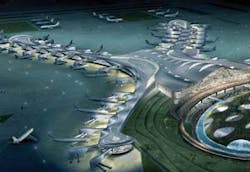
Michael Ibbitson, vice president of information and communications services for Abu Dhabi Airports Company, walked session attendees through his idea of the digital traveler, and how Abu Dhabi International Airport’s new Midfield Terminal (slated for completion in 2015) will accommodate the future traveler.
Asks Ibbitson, “Who is the digital traveler?” In the UAE (United Arab Emirates), “We have 176 percent mobile phone penetration, which means that every adult carries two mobile phones, and generally, it’s a Blackberry for business and an iPhone for personal,” relates Ibbitson. Digital travelers are ones who want to manage their own travel experiences very closely, he explains.
“Our digital traveler in Abu Dhabi is looking for technologies that speed up the process of getting through the airport. They use web check-in predominantly, or with the mobile phone where possible; they’ll use kiosk check-in and they want it for all airlines; they want optional upgrade payments; document checking; frequent flyer management; bag tag printing; and a simple self-service drop-off for baggage.
“If there’s a registered security screening program, our passengers will definitely register online and try to use it; they’re looking for mobile device applications for flight information, airport status; and if self-service boarding is available, they will try to use it.”
Travelers are also looking for free WiFi Internet access, says Ibbitson. “In our airport we deployed free WiFi a year and a half ago, and it’s been an amazing success,” he relates. “We also deployed many free Internet kiosks.
“We are very lucky to be in the design stages of a very major facility [Midfield Terminal]. We’ve considered IT totally as a utility within the building; in fact it is part of our utility master plan for the airport.
“We’re designing the cabling infrastructure like you would water or power with many consolidation points and junction boxes allowing for quick and easily deployment of new IT services in and around the airport.
The technology is not just limited to the digital passenger, relates Ibbitson. Abu Dhabi plans to accommodate for the digital aircraft, the digital ground handler, and digital baggage systems as well. “We are designing the entire WiFi infrastructure out and around the apron and aircraft areas to make sure that wherever whoever is working at our airport has access to our digital services,”
A self-service boarding trial has been requested by the airport’s major airlines, and the Midfield Terminal complex building has been designed with a space reservation for self-service boarding at every single gate, says Ibbitson. Depending on the success of the trial, the company will consider putting it into the final design of the building.
Los Angeles World Airport’s deputy executive director Dominic Nessi agrees with Ibbitson in looking at connectivity at the airport as a utility, not a luxury.
In Nessi’s vision of what airports will be like a decade from now, bandwidth and communication are going to be critical. He predicts that 3-D displays and a variety of different kinds of mobile devices and displays are going to be commonplace.
“Four technologies have impacted the airport environment: smaller and faster mobile devices; cloud computing; communication availability everywhere; and turning data into information,” or ‘business intelligence, explains Nessi.
“Companies like Oracle, IBM, Microsoft, and SAP have spent some $15 million buying software firms that do nothing more than analyze data. Digital information is increasing ten-fold every five years and mobile phones are going to be a major input device into the cloud … the cloud will be collecting data on all of us through our mobile phones.” ‘The cloud’ refers to Internet-based computing, whereby shared resources, software, and information are provided to computers and other devices on demand, like the electricity grid.
“The travelers of tomorrow will demand higher levels of control, comfort, security, and personalization from the travel experience,” says Nessi.
SITA’s Mobile Workforce Solution
The air transport industry is characterized by a constantly mobile workforce and a complex, dynamic workflow model, requiring workers to access and act on real-time information, according to SITA, IT and communications specialists for the air transport industry. SITA’s Mobile Workforce solution enables airlines, airports, and all airport-based service providers to cost-effectively mobilize their business practices, says the company.
In partnership with Motorola Inc, a provider of mobile/wireless technologies, SITA offers the air transport industry a solution incorporating mobile devices in a managed services business model. SITA’s Mobile Workforce solution pairs middleware components and wireless connectivity with Motorola handheld devices, and can enable duty managers to perform up to five aircraft turnarounds simultaneously.
Says SITA’s Sebastien Fabre, “Right now people on the tarmac don’t have access to back-end data, and they cannot make certain decisions, or they cannot get organized to address what’s happening or to be more efficient.
“As soon as you provide them with a mobile device, you can start interacting with them; they can be better informed so they can better manage issues and allocate tasks based on where available people are.
“With the Mobile Workforce solution, the system knows when operators are done with tasks, then you can allocate tasks to people who are who are nearest to the task that needs to be performed. You can be much better at managing your team and your workforce by more efficiently allocating tasks, organizing people, and optimizing operations.”
About the Author
 Brad McAllister