With the Boeing B787’s first flight in very recent past and the promises of the improved efficiency of this new aircraft, I am convinced that significant efforts are being made in reducing the emissions of the aircraft in flight, both due to cleaner burning engines and more efficient aircraft design. However, once the aircraft lands we throw all those benefits out the window with inefficient ground operation policies and procedures. Taxi times measured in the hours that keep jet engines idling, gasoline- and diesel-powered ramp equipment that could be electrified and aircraft APUs that can be replaced by electrically powered ground equipment are examples of emissions and inefficiencies that negate the benefits of these newer, cleaner more efficient aircraft.
Each of these subjects deserves an argument of its own, so let me focus on the use or “abuse” of the APU while on the ground. The APU has three functions: It starts the aircraft’s main engines, provides compressed air to operate the onboard air-conditioner, and provides power to the aircraft when it’s main engines are not running. Two of the three of these functions, the air-conditioning and ground power, are easily replaced by electrical equipment producing one-tenth the emissions of the APU. These two products are referred to as pre-conditioned air and 400 Hertz power.
The National Transportation Safety Board (NTSB) and the federal Environmental Protection Agency (EPA) have already issued regulatory guidelines concerning APU use while aircraft are parked (40 CFR Part 52 [CA105-5-6895]:
“Auxiliary Power Units (APU) - To minimize the use of APU’s, 400 hertz (Hz) ground power and preconditioned air must be available at all gates and locations where commercial aircraft routinely park with passengers aboard (e.g., gates). A supply of 400 Hz ground power is required at all other parking locations where commercial aircraft are routinely serviced (e.g., maintenance locations and overnight parking positions.).”
However, being a guideline, it hasn’t had the “teeth” to spur much action.
Table 1: Based upon a typical 25-gate terminal at a Gateway airport with about 300 aircraft movement per day and reduction of the APU burn time to five minutes per aircraft movement.
|
Emissions
|
APU
|
Ground-based equipment
|
Annual Savings
|
| Hydrocarbons (pounds) |
52,100
|
2,104
|
49,996
|
| Carbon Monoxide (pounds) |
928,908
|
37,233
|
891,676
|
| Nitrogen Oxide (pounds) |
474,244
|
18,516
|
455,728
|
Table 2: Table 2: estimated fuel savings
|
Fuel Consumption and cost
|
APU
|
Ground-based equipment
|
Annual Savings
|
| Fuel Consumption (gallons) |
11,681,000
|
56,407
|
11,680,000
|
| Fuel Cost (US$) |
29,203,000
|
1,140,000
|
29,089,000
|
Beyond these concerns, there are also issues of fuel savings, economics, noise and ramp congestion driving the push to use ground-based equipment instead of APUs.
In many, many locations and circumstances, however, commercial aviation operations continue to run APUs while aircraft are on the ground. If turning them off is a good idea, why is this alteration in procedures so slow in being adopted?
Answering this question requires an examination of the problems created by APUs — as well as an assessment of current realities, which may be discouraging the needed change to ground-based equipment.
How real are APU problems?
Problems created by APUs on the ground are quite real and not at all small in scale. However, they often aren’t perceived and recognized, because they have become facts of life in a multi-faceted and increasing complex airport operations picture.
A good way to get a beginning grasp on APU problems is to quantify them. Data on emissions at airports and fuel usage provide excellent numbers for this kind of analysis.
Overall emissions at airports are becoming a serious concern across the country, and on-the-ground APU usage plays a significant role in generating the three major sources for concern: hydrocarbons (HC), carbon monoxide (CO), and nitrogen oxide (NOx). See table 1 on page 25, which is based upon a typical 25-gate terminal at a Gateway airport with about 300 aircraft movement per day and reduction of the APU burn time to 5 minutes per aircraft movement.
How much difference would using ground-based equipment make?
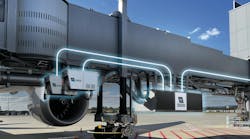
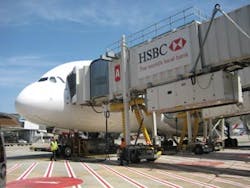
Switching off aircraft APUs while on the ground requires connecting to ground-based power and, when needed, preconditioned air units upon arrival at the gate. Both operations take little time. The APU, then, need not be turned back on until five minutes before pushback from the gate, to power up sufficiently to start the main aircraft engines.
Again, the clearest way to express the dramatic difference made by this reduction in APU usage is through numbers. The fuel savings alone should have the airlines clamoring to get this equipment in operation at every gate they fly into. See table 2.
An unexpected side-effect is the unbelievable noise-reduction at the airport. The ground-based equipment is typically 15-25 decibels quieter than the APU.
What issues are limiting the use of ground-based equipment?
Laziness. It only takes a button in the cockpit to turn on the APU. Ground equipment operation requires the handling of power cables and hoses between the ground-based equipment and the aircraft. Several of the U.S. airlines have figured this out and put major initiatives in place to get the equipment operated and are reaping millions of dollars in savings, not to mention the political benefits of environmental “pats on the back.”
Who wins when APUs are shut down?
There are, indeed, a long list of critical reasons to shut down APUs — safety reasons, regulatory reasons, air quality reasons, noise level reasons, even ramp congestion reasons (bridge-mounted ground power and preconditioned air units mean fewer vehicles moving around in close proximity to aircraft and, thus, less potential for aircraft damage).
But, reflection on a single economic observation suggests the potential scope of all the other advantages to be gained. The observation from a major airline chairman, which appeared in their own in-flight magazine, “For every penny a gallon that our fuel costs increase,” he pointed out, “the bottom line suffers by $27 million a year.” For those of us mathematically challenged, just think of the opposite effect by saving the entire gallon of fuel.
Who wins when APUs are shut down? Everyone who works in the commercial aviation industry. Everyone who flies or relies on shipments by air. Everyone who breathes. In short, everyone.