The Operating Environment
Fortunately for the aviation industry, the fallout from the Copenhagen Climate Change meeting (COP15) wasn’t as toxic as once feared. Indeed, the final Accord didn’t even mention aviation specifically, and so attention turns now to the International Civil Aviation Organization (ICAO) Assembly in late September.
“We found consensus among the delegations that a global sectoral approach should be established for aviation emissions by ICAO, the UN’s specialized agency for aviation,” says Giovanni Bisignani, Director General and CEO of the International Air Transport Association (IATA). “We will work closely with ICAO to prepare a global framework for managing aviation’s emissions for the ICAO Assembly to consider. And we will urge governments to ensure this framework is presented to COP16 in December 2010.”
The industry has already set itself some pretty tough targets. The aim is to improve fuel efficiency by an average of 1.5 percent per year to 2020, and stabilize carbon emissions from 2020 with carbon-neutral growth. This should ultimately lead to a net reduction in carbon emissions of 50 percent by 2050 compared to 2005.
Obviously, achieving these goals will take the efforts of all stakeholders — from ground handlers to aircraft manufacturers. Aviation’s united position on the environment is unique among industry and has already delivered some significant results. Aviation’s carbon footprint in 2008 was just under 670 million tonnes of CO2. That is estimated to shrink by 7 percent for 2009 — 5 percent from the recession and 2 percent as a direct result of the united industry strategy that focuses on new technology, better operational efficiency, improved infrastructure and positive economic measures.
Winning the PR battle
Most ground handlers have long-standing environmental strategies, and these will be vital in the years ahead if aviation is to not only meet its own environmental targets, but also win the hearts and minds of the traveling public.
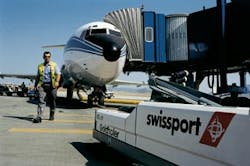
Swissport first formalized its environment strategy in 2003. Michael Thuersam, head of corporate quality, health & safety, says the company is convinced that it is their responsibility to contribute to environmental conservation as much as possible.
“CO2 emissions are not the only issue,” he notes. “But we follow a strict renewal and replacement strategy for all our ground support equipment (GSE). For example, wherever possible and practical, we have all electric bag and cargo tractors in operation — and where not, they will be introduced over the next few years.”
Thuersam adds that Swissport is also working very closely with the major GSE producers in developing new state-of-the-art equipment with lower fuel consumption and emissions. And like many others, the Zurich-based handler has outfitted its diesel vehicles with filters for soot particles. It is also reported to be monitoring how much time its fleet of vehicles have their engines idling rather than switched off. Their vehicles are additionally benefiting from enhanced maintenance schedules, which ensure any emissions are kept to a minimum.
“And besides all of that, we’re also putting great effort into lowering energy consumption in our offices, such as using low energy flat screens instead of the old fashioned monitors,” Thuersam says.
Importantly, Thuersam stresses that Swissport cannot act alone, and all of its projects are undertaken in close cooperation with airports and other local authorities.
Partnerships
Lars Andersen of Scandinavian Airlines agrees that cooperation is often a prerequisite for environmental mitigation, although he suggests there are some activities that can be conducted on a solo basis.
“If new technologies are needed in order to reduce the environmental impact at the airport, it’s often more than one supplier or provider involved,” he says. “Scandinavian Airlines cooperates with all the major airports in Scandinavia in order to reduce the environmental impact at and around the airport.”
At Arlanda Airport in Stockholm, SAS Ground Services works alongside the airport in order to use renewable fuels in all applicable vehicles on airside.
By 2012, the aim is for all airports vehicles to run on renewable fuel or be classified as environmentally clean.
Already, both bio-gas and ethanol are available at the airport, and work is underway to improve the infrastructure for other renewable fuel sources. The airport reports it is even studying the possibility of buying or producing its own biofuel.
New power sources
Other ground handlers around the world from Hong Kong to Frankfurt, are similarly playing their part in aviation’s environmental mitigation work.
Fraport, for example, has successfully trialed vehicles powered by hydrogen fuel cells, which could be the next big move in fuel sources. It has also conducted a study into how it uses its vehicles, the main idea being the avoidance of “empty runs,” where ground support vehicles are unnecessarily used. The airport has introduced a new software system for managing its ground operations, and it’s reported this could save as much as 500 tons of CO2 per year.
Similarly, Brussels-based Aviapartner, which operates at 31 stations throughout Europe, has its new “Visualiser” airport system, which again aims to facilitate more efficient use of its vehicles. The company has also said it is open to the idea of pooling GSE, wherever this makes sense.
Other innovative solutions further highlight the efforts being made by ground support companies. For example, increasing stationary power supply so aircraft don’t have to run their Auxiliary Power Units (APUs) has already reduced emissions at a number of stations.
Waste management is also crucial. The glycols used in deicing are environmentally damaging, and these must be handled with care and disposed of responsibly. One idea is electronic management of glycol content so there is only as much in the mix as the conditions warrant. SAS Ground Services has even looked at infrared deicing, although it found the technique was not best suited to extreme Nordic conditions.
Recycling equipment, reducing water consumption during equipment washes and mobile passenger stairs that operate using solar power further illustrate the commitment being shown in the fight to alleviate climate change. And it’s not just specifics. The holistic view is allowing companies to greatly reduce paper consumption by introducing better software, integrating electronic procedures and files and generally improving operational efficiency.
The fact that Copenhagen didn’t impose any targets on the aviation industry hasn’t affected the ongoing work in environmental mitigation. Ground Handlers have long-standing and far-reaching strategies, and these will undoubtedly help the aviation industry look ahead to a greener future.