The Secure Terminal
denver - at this year's annual ACC/AAAE Airport Design, Build, and Planning Symposium held here last month, airport business magazine caught up with a few industry professionals to discuss airport terminal security ... the good, the bad, and the future.
Participants in the discussions included Steve Cornell, associate vice president and West region aviation director for T.Y. Lin International; Art Kosatka, former TSA project director and current CEO of aviation consultancy TranSecure (also regular blog conbributor for airport business.com); and Peter Muller, former chairman of ACC, and president of PRT Consulting, an engineering consultancy that specializes in PRT (personal rapid transit).
So what makes securing an airport facility a unique challenge compared with other public-use facilities, and why do terrorists continue to target commercial aviation? Comments Muller, "To me, it’s the history of terrorism; air travel has always been a favored target.
"When you cause an airplane to crash, it’s dramatic; terrorists have historically targeted aircraft … and that’s been a primary mission of security - the single-most vital step in that direction was when we secured the cockpit doors after 9/11.
"After 9/11, I immediately started thinking in terms of, we really have to secure the airport; we had to harden the terminals."
Says Cornell, "Air travel is a critical link to the global economy. Terrorists know they can disrupt that link, and cause people to second-guess getting on a plane; aviation is a place where [terrorists] can make the most psychological and economical impact."
Intelligence; profiling
The internationality of American carriers makes them vulnerable, relates Kosatka. "Think of the 188 member nations in ICAO; how many can afford what we do in terms of security?"
"I have mixed emotions about technology, because no matter what that technology is … it’s the kind of thing that you can’t not do; it's a deterrent."
"How many bombs have we found at a screening checkpoint since we started? In virtually every case, the successful interventions of a terrorist scheme have not been detected by technology, it’s been by intelligence.
"I would rather triple the intelligence budget and catch the terrorist three weeks before he comes to the airport, rather than have the technology be, not the first resort, but the last resort in a 20-second pass through a machine."
Very few terrorists are going to challenge the screening checkpoint, says Kosatka, because they know we are looking for them.
With regard to profiling, the Israeli model works well for Israel for a lot of reasons, he explains. "It would not work well at all here.
"One, the entire population in Israel is some 7.8 million; Atlanta screens that many people in a month. Two, EL AL Airlines flies only point to point; it doesn’t do any hubbing. Three, the entire EL AL fleet is less than forty, half of which are grounded at any given time because they are also part of the mobilization fleet.
"Add to that, with some 463 airports here in the U.S. … isn’t going to happen."
The PRT concept
"The question then becomes, why are we married to a physical facility that doesn’t easily lend itself to securing the facility," says Cornell.
Remarks Muller, "The industry has had the mindset of designing security into the existing paradigm of what an airport is. The paradigm shift in the model for securing an airport is to design facilities that are inherently secure from the beginning."
According to Cornell, there are already airport facilities that are remotely checking in people, and remotely securing baggage … Disney and its cruise lines; Calgary International … "Why is that not being thought of as a solution here," he asks?
"Heathrow is doing the simplest thing possible with PRTs," says Muller. "It is simply connecting Terminal 5 with a remote parking facility … there are two stations in the parking lot, one in the terminal, and people park and get on a PRT vehicle to T5 non-stop.
Ultimately Heathrow wants to expand that throughout the landside, and pick up customers from hotels, parking lots, connect the terminals, and have about thirty miles of guiderail and hundreds of vehicles supporting the system, he adds.
In terms of securing the terminal, Cornell and Muller talk of utilizing this concept airside.
"PRT stations can be located anywhere, and directed to the airport," explains Cornell. "People drop bags at the airport and go through a ‘security tunnel’ where preliminary screening takes place. This would utilize technology such as facial recognition, sniffing, scanning, etc … to determine if an individual is a threat."
Once they pass through the security portal, which will end at a PRT station, they board a PRT pod, and are in a contained environment, he relates. During that transit period, people who are identified as non-threats, the vast majority, would be taken to the terminal; the others would be taken to a secondary screening facility.
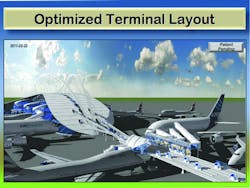
The optimized terminal design would be a multi-layer facility with boarding lobbies that surround a large concessions and retail area. To get to the plane, passengers would go to a contact gate at the mid-level, or go down a level and board a PRT which takes the passenger to the aircraft.
"You’ve then created a shorter terminal with less walking, and an environment where people are going to be comfortable with spending time in the concessions area," says Cornell.
A primary opposition to the concept, says Cornell, is: If you segregate or decentralize the facilities, it will require more people to manage the system.
"The response to that is yes, if you’re not willing to utilize technology for certain functions," "Separate the security functions from the terminal, automate what is possible, and ultimately optimize the use of the facilities."
About the Author